|
Self
catering holiday accommodation in the
south of France, from the Basque country to Languedoc .
Regions:
Southern areas of Midi-Pyrénées, Aquitaine and the Languedoc
Access
Driving
times for Languedoc - Gascony
10 to 14 hours from Calais or Lille under normal driving conditions.
Best
access routes from the UK, Belgium or Holland:
Western sector - motorways via Orleans
Eastern sector: motorways via Dijon and Lyons, or Orleans and
Clermont-Ferrand.
Regional
airports: Toulouse, Montpellier, Carcassonne, Nimes, Pau,
Perpignan.
Peripheral airport: Marseilles
Regional information pages:
The Languedoc
region of France
 Gitelink:
a directory of self catering holiday accommodation for hire directly
from the owners; no agency fees, no commissions. The directory only
lists attractive and well located gites, cottages and
b&bs in France. Gitelink:
a directory of self catering holiday accommodation for hire directly
from the owners; no agency fees, no commissions. The directory only
lists attractive and well located gites, cottages and
b&bs in France.
This directory links
directly to owners' own websites, which provide a detailed and
illustrated presentation of the gite or gites, and - in most
cases - of the area in which they are situated.
Gitelink is a directory specialising in rural properties with
gardens, or properties in a traditional village environment. Many of
the gites in this directory have swimming pools attached.
 L'Annuaire Gitelink
France est spécialisé en gites traditionnels et
locations de vacances dans un cadre tranquil et au calme. Chaque
propriété est présentée sur son site web indépendant, avec une
description détaillée de la propriété, ainsi que de la région où elle
est située. L'exactitude des informations données sur les sites web des
gites, est de l'entière responsabilité des propriétaires des gîtes
concernés.
Accommodation
in other areas of France
|
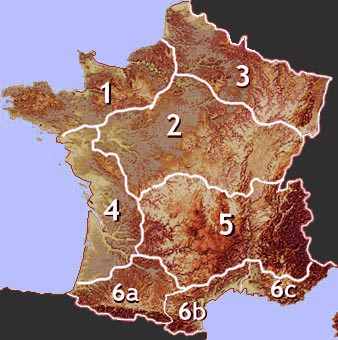
Clickable
map of France
|
► Go straight to the
directory: click on the map or select an area for gites
Area
information in brief..
MIDI
PYRENEES - Gascony
Essential
tourist information
The "Midi Pyrenees"
administrative region of modern France covers a large part of the
lowland area between the Massif Central mountains to the north east,
and the Pyrenees to the south.
Most of this area consists of plain
or of gentle rolling hills, and is not unlike Tuscany in many parts.
The region is strongly agricultural, with production of sunflowers,
corn, vines and other crops.
The Pyrenees,
forming a natural land barrier between France and Spain, are a
beautiful range of high mountains, thickly wooded on their lower
slopes, but offering good mountaineering and hill walking higher up, as
well as skiing in winter - not to mention the attraction of day trips
into Spain. In the west, the Basque
country,
in the department of "Pyrénées Atlantiques" (administratively part of
Aquitaine) is where the Pyrenees, clad with bracken and gorse, come
down to meet the Atlantic. The Basque area has its own culture,
architecture and language, shared with the Spanish Basque region beyond
the Pyrenees.
Biarritz, on the
Atlantic coast, is a very popular resort.
The biggest city in the region, and administrative capital, is Toulouse,
nicknamed the "pink city" on account of the the abundant and historic
use of bricks as building material. Other historic cities include Albi, capital of the
Tarn, with its
astonishing fortified mediaeval cathredal built almost entirely of red
brick, or Foix, capital
of the Ariège. The capital of the Pyrenees, Pau,
is a delightful city, standing before a backdrop of the high mountains
to the south. One other very famous place in the Pyrenees is the
pilgrimage centre of Lourdes.
Click
here for gites in Midi -
Pyrenees
|
LANGUEDOC
Essential
tourist information
This area extends from the peaks and valleys of the Cevennes, in the
north east, to the Spanish border in the south.
The Cevennes,
rising to some 1400 metres at their highest, are beautiful mountains,
with lush forests on their lower slopes, and open hilltops above. The
steep-sided valleys are threaded by roads that twist and turn for miles
on end.
In the north of the region, the Lozere
department is a high dry area stretching from the Cevennes to the
Aubrac plateau.
The coastal strip of Languedoc
is fairly flat, and agricultural, being one of France's biggest
wine-producing areas. It is dotted with small villages and towns, very
Mediterranean in look and feel. Inland from the coastal plain, and
coming right down to the sea in the department of Aude, is the
"garrigue", arid rocky Mediteranean hills with their vegetation of
scrub, aromatic bushes and occasional fields.
The
main cities of Languedoc are Montpellier,
the regional capital, Nimes
famous for its superb Roman remains, Narbonne, Perpignan,
the port of Sète,
and Beziers,
which are very meridional in flavour. The city of Carcassonne, with its
fairytale mediaeval fortifications (a rather romantic
nineteenth-century renovation) is one of the region's most popular
attractions. The Languedoc coast offers large expanses of sandy
beaches, between rather brash modern or sixties resorts such as Cap d'Agde.
Click
here for gites in Languedoc |
Owners:
Add your self catering holiday accommodation to Gitelink France:
Gitelink is a valuable window for owners offering direct-rental gite
accommodation or b&bs in France
For further information in English, check out our gite-owners page |
Propriétaires:
Ajouter
votre site sur Gitelink France:
Gitelink France est une vitrine Internet efficace pour la promotion
internationale de gites et de lchambres d'hôtes en France.
Voir page annonceurs.
|
Copyright
Gitelink France. 2003 - 2016
|


 Ferienwohnungen in Sudfrankreich, von der Rhonetal zur
atlantischen Küste.
Ferienwohnungen in Sudfrankreich, von der Rhonetal zur
atlantischen Küste.
